Showing posts with label Latifa. Show all posts

Thursday, January 28, 2010

Latifa - Fel Kam Youm Elli Fatou

After radically changing her style in Ma'loumat Akideh, Latifa returned to Egyptian pop in 2008, and it is arguably her best pop album to date. The album has a good share of western influence and rich, traditional instrumentation. The title song, which was a huge departure for composer Walid Saad, mixed traditional strings and percussion with the latest French electro music fad, Tecktonik. The idea was Latifa's, and Tamim did a great job bringing it to life. Ana Arfa is written as a frank telephone call between a woman and her friend, and about why her lover refuses to reconcile with her. The arrangement is simple but rich, and reminiscent of Tamer Ali and Tamim's work on Elissa's Awakher El Sheta. The popular Ya Aghla Alb combines a quintessential Egyptian song with a dabke beat, electric baglama, and sharp strings. Sebni Shiwaya is another hybrid, with traditional low-pitched strings and understated percussion, while the composition could easily be used for a western-style ballad. Hankhaf Men Min's romantic lyrics are complimented by simple and relaxed arrangement from Touma. Ana Omri Ma Hansak has less engaging composition, but the arrangement is solid on Medhat Khamis' part, sounding like a remastered classic. Law Faker is a catchy power ballad, but the arrangement seems a bit lackluster for Tamim's usual work. Bi Yekdeb is Tamer Ali at his best, and the ballad opens with a beautiful ney solo, and then turns into a more jazzy number while still maintaining an oriental air. Konna Zaman, is probably the weakest song, and while it has interesting lyrics, the composition is noisy to say the least. Faker Eih and the cheesy Marina are both Latin numbers, and are fun but forgettable. The album also has songs that harken back to Latifa's early career. Rouhi Betrod Feya, composed by Amjad El Atefi, is a simple love song. Law Sahran Habibi, by Iraqi oud virtuoso Naseer Shamma, is also a beautiful love song, but the orchestra here is bigger and the music, especially the oud, is much more engaging.

Image and video hosting by TinyPic

1. Fel Kam Youm Elli Fatou
2. Ana Arfa
3. Ya Aghla Alb
4. Sebni Shiwaya
5. Hankhaf Men Min
6. Ana Omri Ma Hansak
7. Law Faker
8. Bi Yekdeb
9. Konna Zaman
10. Rouhi Betrod Feya
11. Faker Eih
12. Law Sahran Habibi
13. Marina

256 Kbps + Covers

Sunday, December 13, 2009

Latifa - Atehadda

When news of Latifa's Khaliji album came to light, the air of skepticism was undeniable. Latifa has proven us wrong once again, however. After wowing audiences with Ziad Rahbani in 2006, and again with Egyptian pop in Fel Kam Youm Ell Fatou in 2008, Latifa has done it again. While Fella's Khaliji album had a Saudi focus, and Yara's an Emirati one, Latifa's has a Qatari one. As with her previous albums, Latifa tends to excel with slower-tempo songs and she has quite a few excellent ones here, as well as a number of genres. The album has Khaliji pop, like Mamlouh, Atehadda, Wesh Aad Endak, and Ma Yestahel. Then there are songs that mix genres. Einek Le Bara, the story of a lover with wandering eyes, has an interesting gypsy flavor. Ya Anani, arranged by Egyptian-born Ali Abaza, is closer to the Egyptian pop Latifa usually sings. Ana Men Nah Winta Men Nah, composed by George Marderosian, is a fun reminder of the composer's work in the 1990s. Kel Wahed, Ma Jeitni, and Habbeina Gheirah are heartfelt modern ballads, while Weinek Ta'al, Ya Sahrin El Leil and Sabberna Yalli Msabberna are rich, more traditional pieces. Latifa may not have mastered the accent as well as other singers this year, but the album is solid, albeit it could have done without some of the faster tracks.

Image and video hosting by TinyPic

1. Mamlouh
2. Einek Le Bara
3. Atehadda
4. Ma Jeitni
5. Ya Anani
6. Kel Wahed
7. Ana Men Nah Winta Men Nah
8. Wesh Aad Endak
9. Weinek Ta'al
10. Hallaftkom
11. Ya Sahrin El Leil
12. Habbeina Gheirah
13. Sabberni Yalli Msabberna

256 Kbps + Covers

Password: eftekasat.net

Thursday, August 14, 2008

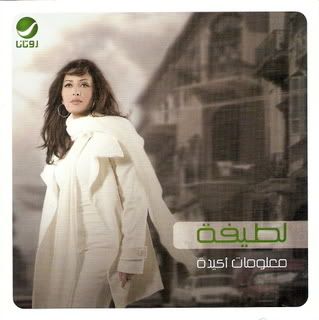
Latifa - Ma'loumat Akideh

Having made the jump from traditional to pop years ago, Latifa is no stranger to change. Even after she starred in Mansour Rahbani's Hokm El Ro'yan play, nobody foresaw her collaboration with Ziad Rahbani until she announced it. Ma'loumat Akideh was Latifa's most controversial album. Critics said she was "copying" Fairuz's style by singing her son, Ziad's, songs. Others criticized Ziad's "vulgar" lyrics in the first single, Bi Nus El Jaw, which used sexual metaphors, and Latifa for singing them. However, for the majority of her listeners, it was a drastic change for Latifa, who has been singing primarily in the Egyptian dialect for years. In Ma'loumat Akideh, Sherif Tag (composed Hayati) was the only Egyptian composer Latifa worked with. The other Egyptian songs, Shofto Be Eini, Ash'ana, and Tefl Esghayar, were composed by Jean-Marie Riachi, Ziad Rahbani, and Marwan Khoury respectively. The remaining songs are all composed and arranged by Ziad Rahbani, including an instrumental piece titled Atil We Darar. Dawwart Iyam El Shetteh, Ma'loumat Mish Akideh, and Ma'loumat Akideh are all western-style jazz songs, in the vein of Fairuz's later jazz hits. Bi Nus El Jaw melds more Arabic music with the jazz, incorporating bouzouk and kanun. My personal favorites; Ammenli Bait, Nafath A Bokra, and Ash'ana have more Arabic and classical instrumentation, and are more reminiscent of Fairuz's earlier work. The richness of Ziad Rahbani's music is enough to make this one of Latifa's best albums.

Photobucket

1. Ma'loumat Mish Akideh
2. Ammenli Bait
3. Ash'ana
4. Hayati
5. Shofto Be Eini
6. Bi Nus El Jaw
7. Tefl Esghayar
8. Nafath A Bokra
9. Dawwart Iyam El Shetteh
10. Atil We Darar
11. Ma'loumat Akideh

Download Here
256 Kbps + Covers