Showing posts with label Iraqi. Show all posts

Tuesday, April 27, 2010

Kadim Al Sahir - Ila Tilmitha

Kadim Al Sahir rarely disappoints, but from time to time come works that are unforgettable. Ila Tilmitha tones down the pop, and while the classical songs are impeccable, the album has a focus on Iraqi songs. The album opens with Ahebbini, a song he has yet to eclipse. The song takes a beautiful Nizar Qabbani poem, couples it with one of Kadim's most powerful compositions yet, and rich, classically-influenced oriental arrangement by Hisham Niyaz. Furshat Raml El Bahr, which Shahd Barmada professed she loved, is an intimate song about lovers on the beach. Ila Tilmitha is a thoroughly oriental affair with one of Nizar Qabbani's most famous poems. The song is arranged beautifully, with moody strings, a calm accordion, and heavy percussion. Sayedat Omri is another heartfelt song, with a slower pace but the same rich feel to the music. Eih Ya'ni changes things up a little, with a more jalsa-style sound, and is another gem. Sayeghin El Thahab, Emshi Bhadawa, and May Ward are lighthearted Iraqi pop songs, while Eshsar Eshda'wa is a full-on Iraqi chobi song. The album closes with Ashkou Ayaman, Kadim's first and less famous duet with Asma Lmnawar. While the song is not the mess Kabberi Aqlaki is, it is more of a recitation when compared to the genre-defining songs that precede it on this album. Ila Tilmitha is a great introduction to the music of the Caesar Al Tarab Kadim Al Sahir.

Image and video hosting by TinyPic

1. Ahebbini Bila Ouqadi
2. Furshat Raml El Bahr
3. Ila Tilmitha
4. Sayeghin El Thahab
5. Emshi Bhadawa
6. Sayedat Omri
7. Kabberi Aqlaki
8. Mawal Ghorfat El Mekyaj
9. May Ward
10. Eih Ya'ni
11. Mawal Dhagat Alaya
12. Eshsar Eshda'wa
13. Ashkou Ayaman (with Asma Lmnawar)

256 Kbps + Covers

Saturday, March 20, 2010

Shahd Barmada - Ba'd Elli Sar

One of the gems found on the countless television talent shows, Shahd Barmada managed to stay on people's minds for years until she finally released her debut album in 2009. With the sweetness of Nancy Ajram, and the grace of Mayada El Hennawi, Shahd Barmada is another very promising new Syrian voice. Musically adopted by Asalah's ex-husband and producer Ayman El Dahabi initially, Shahd later signed on to Music is My Life and Samir Sfair took Ayman's place. Samir composed half of the songs, and his style is diverse as usual.

While Shahd's album is nothing groundbreaking, the choice of songs is perfect with talented musicians coming together for on of 2009's best albums. The catchy title song employs Tarek Madkour's classic strings and kanun combination albeit with an ayoub beat instead of maksoum. La Youshtara successfully brings back Yuri Mrakadi's tried and true formula of beautiful classical lyrics combined with western pop. La Tloum is another infectiously catchy maksoum song, but although Karim Abdelwahab blatantly employs Tarek Madkour's style of arrangement, the synths sound cheap and don't do the song justice. Halati Hala is a simple ballad, with Tarek Madkour's favorite pop beat coupled with clarinet, but as we have come to expect from Karim El Iraqi, the lyrics are heartfelt. Allah Ma'ak is a classic Samir Sfair ballad, and Fahd does a great job combining the elements of the quintessential western ballad with oriental accents. Khaled El Bakri composed two ballads here also. Law Kont Btehlam has a dramatic flare that is in large part thanks to the interesting arrangement of Tarek Aakef. Wayak Habibi is less interesting in terms of composition, but equally beautiful thanks to Medhat Khamis' arrangement. The song that instantly catches your attention however, is Law Had Shafou, composed by Nouhad Najjar. The song is unmistakably oriental, but with a classical accent that Jean-Marie Riachi employs beautifully in the arrangement also. Walid Saad's Reg'et Ayamna is the composer at his best, with a nostalgia and the kind of composition that puts Shahd's beautiful voice to the test. Adel Aayesh's rich, Turkish-influenced arrangement fits perfectly too. The album ends with Teshoufak Eini, a catchy maksoum song that is instantly reminiscent of Nancy Ajram. Funnily enough, the song was apparently meant for Nancy Ajram but Mohamed Rehim preferred to release it sooner.

Image and video hosting by TinyPic

1. Ba'd Elli Sar
2. Law Kont Btehlam
3. La Youshtara
4. Law Had Shafou
5. La Tloum
6. Wayak Habibi
7. Halati Hala
8. Reg'et Ayamna
9. Allah Ma'ak
10. Teshoufak Eini

256 Kbps + Covers

Tuesday, February 24, 2009

Layal - Fi Shouq

Lebanese singer Layal's debut album makes the most of her relatively limited vocal range. The young singer sang at various Beirut cafes and restaurants before finally meeting with musicians like Richard Najm, Tony Abi Karam, and Salim Salameh The album has a variety of styles, covering Egyptian and Lebanese ballads as well as a shot at Iraqi chobi. Her first single, Hawasi Kella, is included as well as an unexpected collaboration with Ihsan El Mounzer, who arranged Mashghoul Bali Alaik. Easily Jad Sawaya's most (professionally) serious artist so far, Layal's debut album is a good start, with lots of room to improve.

Image Hosted by ImageShack.us

1. Fi Shouq
2. Hawasi Kella
3. Abouya Alli
4. Mashghoul Bali Alaik
5. Am Behlamak
6. Wen Ya Wen
7. Chobi
8. Albi Yomma

Download Here
256 Kbps + Covers

Sunday, December 14, 2008

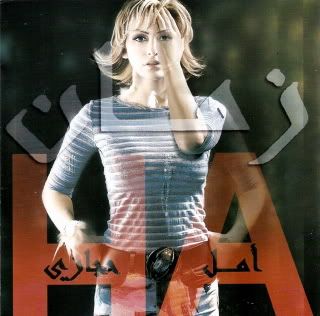
Amal Hijazi - Zaman

Amal Hijazi's second album is, arguably, her most successful to date, and most people usually assume that this was her debut album. When you see how many of her hits came from this album, it's easy to see why. Producer Jean Saliba's affinity for Bendeniz continues in this album, and the title song is a cover of the Turkish singer/composer's own 2001 hit of the same name. With the exception of the last two tracks, the album has an oriental flavor throughout, regardless of the style of composition. The album starts with the catchy Ed'ili, Amal's first and only collaboration with Amr Mostafa. "Prince of Rai" Faudel joins Amal on Ainak Ainak, the hit Rai song which proved again Tarek Abou Jaoudeh's diversity as a composer. Iraqis Ravi and Omar compose and sing with Amal. Waili Wah. Romansiya, composed by Mohamed Rahim, is a catchy pop song which mixes in strings and mizmar with western beats and guitar. The hit Oulhali, one of Nasser El As'ad's best songs to date, is an almost magical song which combines a pop beat with oriental strings and even Indian tabla. Zaman has something for everyone, and that's probably why it's Amal's most memorable album yet.

Photobucket

1. Ed'ili
2. Zaman
3. Ainak Ainak
4. Waili Wah
5. Ya Allah
6. Zein El Rouh
7. Romansiya
8. El Hawa
9. Oulhali
10. Albi Dawwa
11. Comme Çi Comme Ça
12. Mali Meil

Download Here
256 Kbps + Covers

Tuesday, October 21, 2008

Shams - Shams (2007)

After her 2005 album, Mudhahara Nesa'iya (Women's Rebellion), Shams stayed out of the public eye for a long period of time. The news of the termination of her Rotana contract made many think that her career could only be headed downwards. She returned however, in 2007, with a strong pan-Arab promotional campaign and a controversial video that satirized the American politics in the Middle East, Ahlan Ezayak. Now signed on as Surpr!se Entertainment first artist, Shams' return couldn't have been stronger. Her new album contained two (very different) discs, the first in the Khaliji/Gulf and Iraqi dialects, and the second in the Egyptian dialect.

Photobucket

Abdelqader El Hedhoud composed the majority of the first disc, with the exception of tracks 3, 5, and 6. The album opens with Million, a lighthearted and comedic song arranged by Tarek Aakef, who gives the song the strong percussion he likes to use on his Khaliji work. Tarek Aakef arranges the most traditional-sounding songs on the album, Million, Ba'ad Omri and La Tetawel Lesanek included. La Tgoul Ma Aridek, composed by Samer Rashed and arranged by Walid Fayed, is the album's sole Iraqi song. Nadhra, which borders on the noisy, is given the Egyptian maksoum treatment by Dr. Ashraf Abdo. The remaining songs have a very different sound, the arrangers, Mohamed Mostafa, Medhat Khamis, and Karim Abdelwahab, are from Egypt, while Ismail T. Black hails from Turkey. Mohamed Mostafa arranged Afia Alay and the hit Loha Me'aqeda, both ballads that he did an excellent job on, though he took a more traditional approach with the former. Tefl, also arranged by Dr. Abdo, is a mix of both oriental instruments and western beats, and very different from Nadhra (in a good way). Karim Abdelwahab does his best work on ballads, and Halat Ferag is no exception, because he makes sure that a slow song doesn't have to be a boring one. The first disc bows out with Qessa Aalamiya, which İsmail Tunçbilek arranges, using his signature strings (which you can hear on Al Hob Wal Wafa', as well as Nawal's El Shoug Jabek and Ma'goula Tensani) combined with clarinets and a purely Iraqi beat.

Photobucket

1. Million
2. Loha Me'aqeda
3. Ba'ad Omri
4. Nadhra
5. La Tgoul Ma Aridek
6. Sema'na
7. La Tetawel Lesanak
8. Afia Alay
9. Tefl
10. Halat Ferag
11. Qessa Aalamiya

Disc 1
256 Kbps + Covers

The majority of the songs on the second disc of Shams' album tend to either be comedic (and subsequently noisy at times) or beautifully sung and composed ballads. Shams' pronounciation is excellent for a Kuwaiti native, though at times her voice does falter. Mohamed Diya'eddin, who is credited with much of Asalah's early success, composed and arranged five songs on this disc. Mohamed Rahim's composition, Ahlan Ezayak, opens the second disc on a lighthearded note also. Ana Arfa is not as interesting, but it's followed by the album's second single, Ghammadt Eineik, which Shams shot a meaningful video for, depicting the life of a person riddled with a drug addiction. Wakhed Balak and Neb'ed Youmein are musically neutral, maksoum songs, with nothing interesting or off-putting. Moush Eshq La, by Mohamed Diya'deddin, has a beautiful, traditional orchestra-style feel to the music. Za'lan and Eih Dah Aslo, an annoying shot at hip-hop, are the album's low points, with not much in terms of lyrics or music to appreciate. However, listening to the great work done on songs like Albi Be Youga'ni (composed by Mohamed Rifai, arranged by Karim Abdelwahab) and Lazem Asibak (composed by Walid Saad, arranged by Mohamed Mostafa) is gratifying enough to make you forget the not so stellar songs. Shams just released a video for Ta'ta'ah (Stutters), the love-it or hate-it song of the season, with mixed reviews. Some simply hate the shrieking Shams does, others love the comedic lyrics and the funny video which portrays Shams as a corrupt judge in what appears to be a red devil suit. As always, Shams also injects some politics under the surface of the video.

Photobucket

1. Ahlan Ezayak
2. Ana Arfa
3. Ghammadt Eineik
4. Wakhed Balak
5. El Wa't El Mounaseb
6. Ta'ta'ah
7. Albi Be Youga'ni
8. Za'lan
9. Moush Eshq La
10. Neb'ed Youmein
11. Lazem Asibak
12. Eih Dah Aslo

Disc 2
256 Kbps + Covers

Friday, October 10, 2008

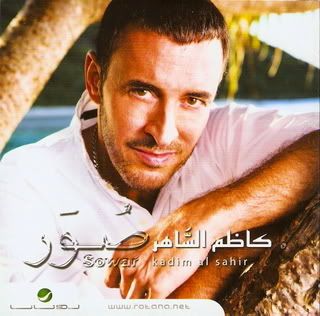
Kadim Al Sahir - Sowar

Kadim Al Sahir, a.k.a. the Caesar of Arabic Song, hasn't put out an album like Sowar in years. Having garnered the majority of his success from grand songs that brought life to the poetry of the great Nizar Qabbani the past few years, many of Kadim's old fans missed the days when he sung songs that were purely Iraqi. Kadim's 2008 album consists of thirteen tracks, primarily in the Iraqi dialect, and mostly upbeat tracks he composed himself. The album opens weakly with Set El Helwat, which is too stylistically similar to Kadim's 2005 hit, El Ebnaya. Ensa El Aalam, the album's first single, picks the album up and sets a much more suitable tone. Akhiran, a slow ballad, takes the speed down a notch, but Alamak picks up where Ensa El Aalam left off and brings back the Iraqi percussion and playful lyrics. Teheb Tetdalla' and Sadaf are typical Kadim songs, with a pace that is not too slow, and expressive lyrics. Makheth El Rouh and Om El Sheila are also enjoyable songs with a traditional style, even incorporating the clapping typical of Iraq and the Gulf region. Tehebbeni and Sowar are the two Khaliji songs on the album, composed by Mohamed Shafiq. Aayel, an old Iraqi folk song, and Hat Hodnak round up the Iraqi songs on the album, and the album ends with a Nizar Qabbani poem, Ma'a Baghdadiya.

Photobucket

1. Set El Helwat
2. Ensa El Aalam
3. Akhiran
4. Alamak
5. Teheb Tetdalla'
6. Om El Sheila
7. Makheth El Rouh
8. Sowar
9. Sadaf
10. Tehebbeni
11. Hat Hodnak
12. Aayel
13. Ma'a Baghdadiya

Download Here
256 Kbps + Covers

Tuesday, September 9, 2008

Dania - The Best of Dania

This album is a compilation of Dania's first three albums, Dania, Dania 2, and El Hilwa Di, as well as her Listen to My Heart single. Her 2008 comeback single, Rayah Albak, is not on here though. While Dania did not have many of "her own" hits, she brought life back to a vast number of old Arabic folk songs, and sang in countless styles with international musicians. Foug El Nakhal is an Iraqi folk song, and is remixed here by Said Mrad and Dani Helou. El Hilwa Di (Coucou) is another old song by Sayed Darwish (the Egyptian musician behind Dalida's international hit Salma Ya Salama). Though the song has been reinterpreted many times, Dania and Jean-Marie Riachi's version became an international club hit and the original, as well as two of the countless remixes are included here. Ya Dallah, which is one of Lebanese songstress Sabah's biggest hits, is remixed into an Arabic-dance fusion song by Phillip Khayat. Yalla Bina, which has been remixed by Dalida and Ishtar Alabina before, gets an Indian-style remix here. UK DJs Transglobal Underground's remix of Leiley is in their typical world fusion style, keeping the original strings while mixing in Indian and electronic beats. Para No Verte Más and Cha Cha Cha, both La Mosca Tsé-Tsé songs, as well as Fiesta are the album's Latin-sounding songs. Private Number (a duet with 911) and Listen to My Heart are both in English, though the latter is not a translation of El Hilwa Di. Afrahou Gannouh and La Tehtar are both Greek songs remade by Dania, one is an upbeat laika song and the other a ballad. Ya Akhed Akley, another great Arabic-western fusion, and Ana Baddi, the most traditional-style song on the album, are the two original Dania songs on the album.

Photobucket

1. Foug El Nakhal (1001 NIGHTSociety Remake)
2. Cou Cou (Beirut Biloma Chillout Version)
3. Leiley (Transglobal Underground Remix)
4. Yalla Bina (Bhangra Remix)
5. El Hilwa Di (Coucou)
6. Ya Dallah
7. Fiesta
8. Para No Verte Más
9. Ya Akhed Akley
10. La Tehtar
11. Mafeesh Tari'a (99 Remix)
12. Cha Cha Cha
13. Afrahou Gannouh
14. Ana Baddi
15. Private Number (with 911)
16. Listen to My Heart (Cou Cou)

Download Here
256 Kbps + Covers

Friday, June 27, 2008

Mayssam Nahas - Bonita

Mayssam's 2003 album was a enormous hit for her and shows the first fruits of her collaboration with her now ex-husband, Roger Abi Aqil, who composed five of the ten tracks. Mayssam met with great success with such songs as Lamouni, Nar Nar, Bonita, and Kol El Shouq (composed by Turkish composer Altan Seytin).

Photobucket

1. Lamouni
2. Nar Nar
3. Bhebbak Be Jnoun
4. Bonita
5. Ward
6. Kol El Shouq
7. Leila Dana
8. Amshilak
9. Shou Ma Sar
10. Teheb Tes'al

Download Here
256 Kbps + Covers

Wednesday, June 25, 2008

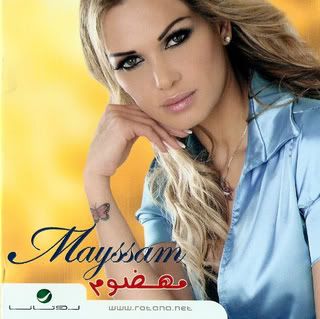
Mayssam Nahas - Mahdoum

Mayssam Nahas' 2008 album is arguably her best so far with so many genres fit on one CD. She has explored Iraqi, Egyptian, and Lebanese dialects and in numerous forms. Mahdoum (Loveable) exhibits the best vocal skill Mayssam has shown so far, and she has worked with numerous musicians she has never before collaborated with such musicians as Yaser Jalal (who composed Hasna's hit Shoufo Shoufo), Jean Saliba, Aytekin Kurt (who recently remixed Jan Jnouni for Assi Al Hillani), Yehia El Hassan, and George Marderosian. Mohamed Kebbi (a.k.a. Beirut Biloma) does an amazing job arranging Mogarrad Sou'al, and along with Mayssam's expressive voice you are transported to another time. Apart from a few hiccups on Betfa'el Fik and Hatrouh Ba'id, Mahdoum is one of 2008's best, with songs that feel modern but have a refreshing air of nostalgia. It's worth noting that Habib El Rouh is a cover of Wallah Ma Faragni, a song from Abeer Fadda's 2005 album, Inta Malak. Mayssam makes the song her own however, with very different arrangement and a slower, more heartfelt approach.

IPB Image

1. Mahdoum
2. Behlam Be Eyounak
3. Rouhi Btendahlak
4. Habib El Rouh
5. Mogarrad Sou'al
6. Neseitak
7. Betfa'el Fik
8. Lamset Eidayeh
9. Basshar Layali
10. Hatrouh Ba'id

Download Here
256 Kbps + Covers